
Stumped by Tree Troubles? We're Here for You! - Get Your FREE Estimates!

Stumped by Tree Troubles? We're Here for You! - Get Your FREE Estimates!

 By
Big Easy Tree Removal
 Oct 24, 2025
 0 Comments
Modern tree removal in New Orleans, LA relies on five key safety innovations: advanced machinery, smarter personal protective equipment, remote-controlled operations, digital planning tools, and enhanced on-site communication systems. Big Easy Tree Removal uses these technologies to protect property owners and workers throughout Southeast Louisiana, especially during the demands of hurricane season and year-round storm recovery.
New Orleans homeowners deal with tree hazards that most of the country never has to consider. Hurricane season runs from June through November, and tropical storms can weaken root systems in the city’s saturated, low-lying soil almost overnight. Live oaks stretching across Uptown streets, towering cypress trees in Lakeview, and dense canopies throughout the Garden District all present unique removal challenges when they become compromised. That is why Big Easy Tree Removal invests in the latest safety innovations to protect both property and people across the Greater New Orleans area.
The combination of high humidity, heavy rainfall, and aging infrastructure means that a single storm-damaged tree can threaten power lines, historic homes, and neighboring properties at the same time. Traditional removal methods that might work in drier climates fall short in Southeast Louisiana, where soft ground, frequent flooding, and dense urban lots demand a higher level of precision and protection. Below are the five most important safety innovations shaping how tree removal is performed in New Orleans today.
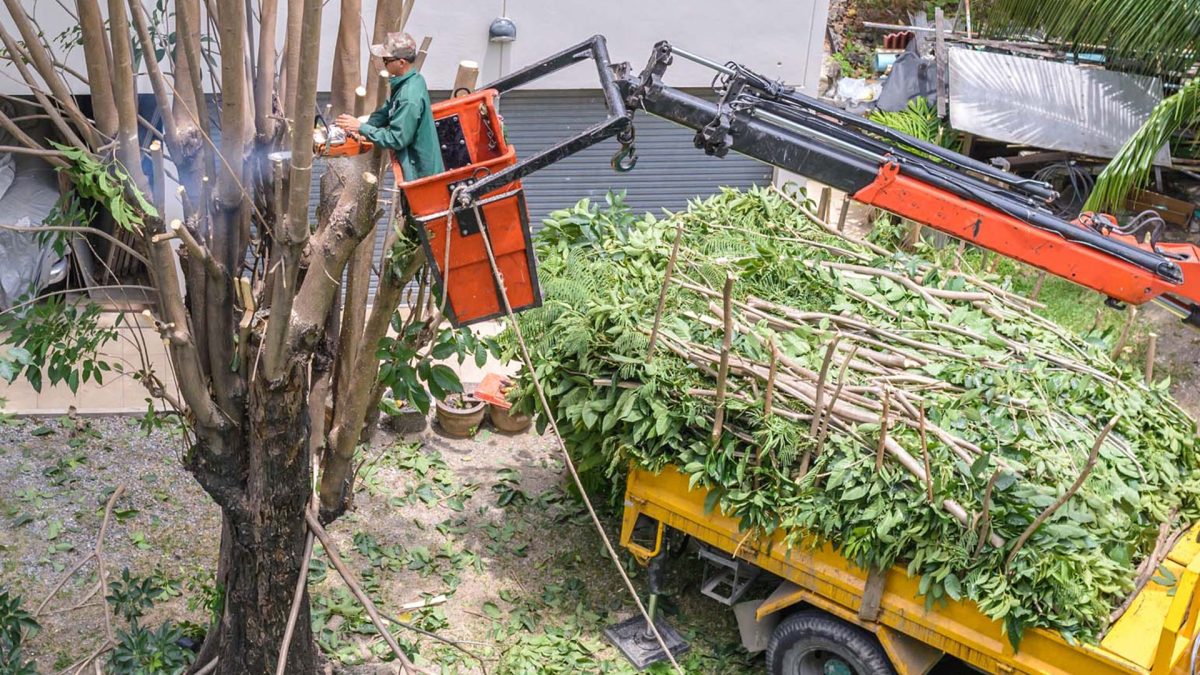
Specialized cranes with grapple saw attachments allow workers to control heavy limbs from a safe distance, significantly reducing the physical risk of removing storm-damaged or structurally compromised trees common throughout Orleans and Jefferson Parishes.
In a city like New Orleans, where mature live oaks can have canopy spreads exceeding 100 feet, the right machinery is the difference between a controlled removal and a dangerous situation. Grapple saws mounted on crane booms let operators grip, cut, and lower large branches without putting anyone beneath the load. This is especially critical after hurricanes, when partially uprooted trees lean unpredictably against rooftops and utility lines in neighborhoods like Mid-City and Gentilly.
Modern stump grinders have also advanced considerably. Older grinding methods produced heavy vibration and required the operator to stand within feet of the spinning carbide teeth. Today’s grinders feature remote throttle controls and automated depth settings that keep operators at a safer position. Whole-tree chippers handle debris more efficiently as well, reducing the time workers spend near unstable trunk sections. For properties along St. Charles Avenue or in the Marigny, where tight lot lines and historic structures leave little room for error, this precision equipment prevents collateral damage to fences, sidewalks, and neighboring buildings.
Next-generation personal protective equipment includes helmets with integrated communication systems, cut-resistant clothing rated for chainsaw contact, and wearable sensors that monitor fatigue and heat stress in real time on the job site.
New Orleans heat and humidity create conditions where heat exhaustion is a genuine occupational hazard from April through October. Standard hard hats and work gloves are no longer enough. Current helmets incorporate Bluetooth communication, allowing every person on site to hear instructions clearly over the noise of chippers and chainsaws. Cut-resistant chaps and gloves made with Dyneema fiber protect against saw kickback, while slip-resistant boots with ankle stabilization help workers maintain footing on the wet, root-buckled ground found throughout the city.
Wearable biometric sensors represent one of the most meaningful advances for Louisiana work conditions. These devices clip to a vest or hard hat and track heart rate, core body temperature, and movement patterns. When a worker’s readings indicate the early stages of heat stress, a notification goes to the site supervisor before the situation becomes an emergency. Given that Southeast Louisiana regularly sees heat index values above 110 degrees Fahrenheit during summer months, this technology has a direct impact on preventing heat-related incidents.
Drone inspections and remote-controlled cutting equipment allow workers to assess and address tree hazards without climbing into compromised canopies or standing beneath weakened trunks, which is particularly valuable after tropical storms pass through the New Orleans metro area.
After a major storm moves through Southeast Louisiana, homeowners in neighborhoods from Algiers Point to Lake Terrace often discover trees with hidden structural failures. A trunk may appear intact from the ground while rot or wind fractures compromise its interior. Drones equipped with high-resolution and thermal cameras can survey these trees from every angle in minutes, identifying cracks, cavities, and deadwood that are invisible from below. This aerial assessment replaces the need for someone to climb a potentially failing tree just to evaluate it.
Remote-controlled grapple saws take this a step further. An operator on the ground can position a saw arm to make precision cuts on heavy limbs while standing well outside the drop zone. Teleoperated equipment is especially useful for leaning trees on sloped lots near the Mississippi River levee or in areas where saturated soil has destabilized root plates. By keeping all personnel away from the most dangerous phases of the operation, remote technology has meaningfully reduced injury rates in the tree care industry nationwide.
LiDAR scanning, GIS mapping, and 3D site modeling allow arborists to measure tree dimensions, map underground utilities, and simulate removal sequences on a screen before a single cut is made on the property.
New Orleans presents a unique planning challenge. Underground utilities, century-old sewer and water lines, and the city’s distinctive above-ground root systems all complicate removal logistics. Digital planning tools address this by creating an accurate three-dimensional model of the work site. LiDAR (Light Detection and Ranging) sensors can measure a tree’s height, lean angle, and canopy density within centimeters of accuracy. When combined with GIS data showing the locations of buried gas lines, electrical conduits, and drainage infrastructure, the result is a removal plan that accounts for hazards both above and below ground.
This technology is particularly valuable for properties in the French Quarter, the Warehouse District, and other dense urban areas where drop zones are extremely limited. A 3D model lets the planning team determine exactly where each section of trunk and limb will land, which rigging points to use, and what sequence of cuts will keep the load path clear of structures. For large-scale storm cleanup across multiple properties, satellite imagery helps prioritize which trees pose the most immediate danger, directing resources where they are needed first.
Digital two-way radios, GPS tracking, and wearable communication devices keep every member of a removal operation connected in real time, which prevents the miscommunication that historically causes the majority